I'm worried that my child doesn't hear well. What should I do?
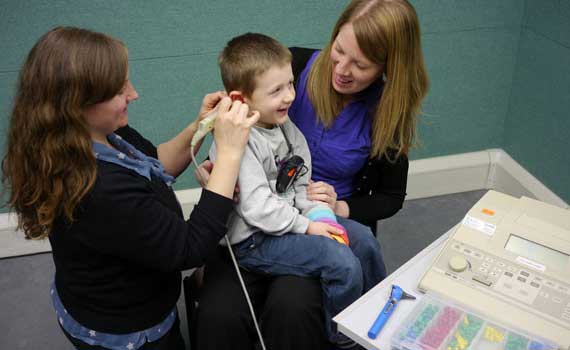
Parents are usually the first to notice that their baby does not appear to be responding
to sound. Nowadays all newborn have their hearing tested at birth, but if for some reason
you have doubts about the results of these tests at a later stage then trust your instincts
and get your baby tested right away!
top of page ^
Why is my child deaf?
In some cases, the cause of deafness (etiology) is easy to determine.
Heredity, high fevers, illnesses such as meningitis, complications during pregnancy or
childbirth are some other causes.
In many other cases, the cause is more difficult to determine and may never be discovered.
There may also be several other factors that contributed to the hearing loss. Perhaps there
is no apparent reason for deafness. In such cases, the etiology is listed as unknown.
top of page ^
Will my child be normal?
If by normal you mean "will my child run and play, go to school, learn to read, have friends,
drive a car, have a job or career, get married?" the answer is almost certainly "yes." If
it means, "will my child be exactly the same as a hearing child?" the answer is "no." There
are differences between children with normal hearing and children who are deaf or hard or
hearing. The primary difference is in the way they will learn to communicate.
top of page ^
How can I communicate with my child?
There are lots of different methods of communication available to help your child learn to
communicate. However, one unifying factor is that they all involve you, the parents. No matter
which method of communication you choose, you are the main educator for your child and may
need to learn some new skills. It will take time, energy and patience for you to learn them
but with the right early intervention could prove to be the most rewarding thing you do! Deaf
children who learn to communicate at an early age and who are included in family interactions
have a good chance for success, both academically and personally.
Learn all you can about all methods. This will help you decide which one is best for your
family! No one method is right for every child. To learn about some of the different methods of
communication see www.ncbegin.com)
top of page ^
How Do I Make A Decision About Which Method To Use?
Making a decision on which path to go down for your child is a very difficult thing. What you
must remember is that they are too young to make this decision themselves and will be relying
on you to make the right choice for them. Making an informed choice is the best possible way
forward, so spend time and effort getting informed.
The most important thing to do is to make a decision, rather than no decision at all. Deaf
children need early language and communication intervention in order to succeed in ‘normal’
life. In making the choice for a method of communication, you must consider the amount of
your child’s loss and what suits your child and you as a family. Ask as many questions as
you need to understand each of these factors. Talk with other parents and compare the
advantages and disadvantages of each possible approach for your child and your family.
It’s extremely important to make a choice, maintain interaction, and provide your child
clear and consistent language input.
But remember, no decision is irreversible. You may feel some consolation from knowing that
you can review decisions about communication methods and educational programmes each year,
and add to them or adapt them. These decisions can be changed, as necessary, to provide your
child with the best chance to reach their full potential
top of page ^
I don’t know where to start. Am I Normal?
Most deaf babies are born to hearing families with no history of deafness – and it is
a shock to them all. A diagnosis of hearing loss brings emotions of fear, loss, panic
and huge sadness and parents can sometime receive conflicting information from different
professionals when a baby’s hearing loss is first diagnosed. Once a reliable diagnosis
is made, parents start learning about the many communication approaches available,
about amplification options or cochlear implants, and about services and educational
programmes available. It is a journey and the start of any new journey can be daunting,
but don’t be put off – the sooner you tackle this journey the better it will be for
you and your child.
It will feel frightening at times! Don’t worry, you are normal.
top of page ^
When can a child be fitted with hearing aids?
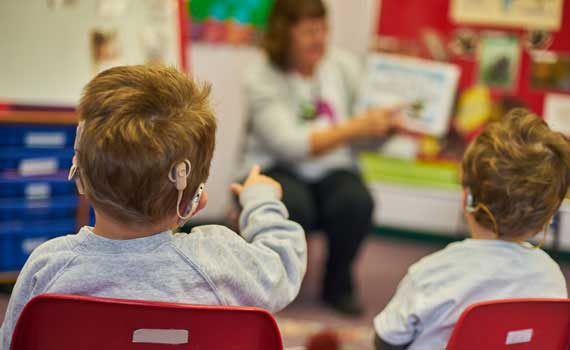
Most children with a sensorineural hearing loss are fitted with hearing aids right away.
Only through ongoing and consistent testing can your child’s audiologist help you find the
best aids and the correct setting for your child’s loss. Hearing aids do not cure a hearing
loss. In most cases, children with hearing losses can learn to detect and discriminate
the sounds of spoken language through hearing aids. This will help your child learn to
communicate through speech and be aware of the sounds around him. If hearing aids have
been recommended for your child, it is important that the aids are worn on a full-time
basis, as soon as possible.
top of page ^
What is a cochlear implant?
For the small group of deaf children who do not receive enough benefit from hearing aids,
a cochlear implant may be recommended. You will need to work closely with your child's
audiologist and teachers to find out whether or not your child is a candidate for this
procedure.
For more information about cochlear implants view our special papers
top of page ^
What will happen when my child starts school?
Decisions regarding your child’s educational placement, now and in the future, will depend
upon many factors. Deaf children should be placed in school programmes depending upon the
needs of the individual child. You, the parents, will play an active role in making decisions
regarding your child’s school programming and educational placement and the professionals
working with you will give you support to do this.
Some children who are deaf are completely mainstreamed into school, usually after developing
a language system. These children often require special support services so that they can
benefit from their regular classroom settings such as a Learning Support Assistant.
Some children who are deaf are placed in programmes with other deaf children because this
is more appropriate for them, and which can be attached to a mainstream school in a ‘unit’.
Many deaf and hard of hearing children spend some of their day in classes with other deaf
children, and some of their day with their hearing peers.
The third option is for your child to go to a specialist school for the deaf.
top of page ^
What help will I get with my deaf baby locally?
All children with special needs, who live in the UK, are eligible for a FREE local authority
support and guidance from day of diagnosis. Your child may begin receiving assistance from
your local education agencies, even as an infant. No child is too young to receive needed
services. Contact your local health authority and local education authority if this has not
already been done and enquire about their programs and services to help you and your child.
Most commonly a deaf child would be entitled to regular visits from a Teacher of the Deaf,
regular appointments with an Audiologist, routine assessments from and Educational Psychologist
and sessions with a Speech and Language Therapist.
top of page ^
What benefit payments am I or my deaf child entitled to?
There are two types of routine benefits that you can claim if you have a child with special
needs. The first is called a Disability Living Allowance (DLA) which is available to all
children with a disability. The second is the Invalid Carers Allowance which is available
to parents or carers who have forgone their income in order to care for their child with
special needs.
top of page ^